Tag: Homeowners

Residential backyard with well-kept grassy lawn, surrounding trees and shrubs, and a wooden playhouse partially hidden by foliage.

My neighbour put a fence on my property: a guide to boundary disputes in BC

Discovering that a neighbour’s fence may be sitting on your property is one of the most common causes of boundary disputes across British Columbia. Whether you live in Victoria, Nanaimo, Campbell River, or elsewhere on Vancouver Island, these situations often create immediate stress surrounding property rights, privacy, liability, and future property value.

At Polaris Land Surveying, we act as the neutral legal authority in property boundary disputes. Before homeowners escalate matters to lawyers or court proceedings, it is essential to establish the technical facts through a professional land survey.

Here is what property owners should know about fence disputes, property lines, and boundary encroachments in BC.

1. Understanding Fence Disputes and Shared Property Lines

One of the first questions homeowners ask during a fence dispute is who is responsible for paying for a shared fence.

In British Columbia, if a fence is built directly along the legal property line, neighbouring property owners are generally considered equal partners and often share responsibility for maintenance and repair costs. However, a neighbour cannot simply force you to pay for a new fence without prior agreement regarding the type, location, and cost.

If a neighbour installs a fence without your consent, the fence should remain entirely within their own property boundaries. If it crosses onto your land, it may legally qualify as an encroachment or trespass.

A professional survey is often the fastest and most reliable way to determine whether a fence actually sits on the legal property line.

2. Fence Bylaws Vary Across Vancouver Island Municipalities

Fence regulations differ significantly between municipalities across Vancouver Island. A fence that complies with bylaws in one community may violate regulations in another.

Some common examples include:

  • Victoria and Duncan: Residential fences are typically limited to 1.2m (4ft) in front yards and approximately 2.0m (6.5ft) in rear or side yards.
  • Nanaimo: Rear and side yard fences may reach up to 2.4m (approximately 8ft), while front yard fences remain restricted to 1.2m.
  • Campbell River: Most residential fences are limited to 1.8m, with lower height restrictions near front property lines.
  • Comox Valley: Fence height allowances vary depending on whether the fence borders a roadway or neighbouring property.

In most municipalities, standard fences do not require building permits. However, retaining walls over certain height thresholds often do require permits and additional engineering or survey review.

Understanding local bylaws early can help homeowners avoid municipal complaints and costly redesigns.

3. How Property Lines Are Proven in British Columbia

Many homeowners assume old fence lines, landscaping, or verbal agreements determine property boundaries. In reality, legal property lines in BC are established through professional land surveying methods and historical legal evidence.

When determining property boundaries, a BC Land Surveyor relies on:

  • Natural boundaries, such as shorelines or creeks
  • Original survey monuments and iron pins
  • Historical evidence of land occupation
  • Measurements from registered legal survey plans

At Polaris Land Surveying, we often prepare a Posting Plan, which formally identifies and marks legal property corners using physical survey stakes. In some situations, a Location Certificate or Surveyor’s Certificate may also be prepared to show how structures relate to the legal boundaries.

This provides homeowners with accurate, legally defensible information before disputes escalate further.

4. What Happens if a Fence Encroaches on Your Property?

If a survey confirms that a neighbour’s fence crosses onto your property, the structure is considered an encroachment under BC property law.

Although property owners may pursue legal action for trespass, British Columbia courts often prefer resolving encroachment disputes through the Property Law Act. Depending on the situation, the court may:

  • Order removal: Require the encroaching fence or structure to be dismantled and removed.
  • Grant an easement: Allow the fence to remain while compensating the affected property owner.
  • Transfer ownership: Require the sale of the affected strip of land to the neighbouring owner at fair market value.

In many cases, courts reserve forced removal for situations involving intentional or reckless encroachments. Minor accidental encroachments are more commonly resolved through easements or negotiated settlements.

5. Boundary Disputes Often Involve Drainage and Property Damage

Fence disputes frequently expand into broader conflicts involving drainage issues, retaining walls, overhanging trees, and property damage.

For example:

  • Improper drainage from a neighbouring property may contribute to flooding or erosion.
  • Overhanging branches or roots may damage fences, roofs, or landscaping.
  • Retaining walls constructed too close to property boundaries can create liability concerns.

Under BC law, property owners generally have the right to trim branches or roots extending onto their side of the property line, provided they do not trespass or seriously damage the health of the tree.

A professional survey helps establish exactly where these features are located in relation to the legal boundary, reducing uncertainty and helping resolve disputes more efficiently.
——————————————————————————–

Boundary Dispute Checklist for Vancouver Island Property Owners

If you are involved in a property line or fence dispute, consider the following:

  • Has the legal property line been professionally verified by a licensed BC Land Surveyor?
  • Does the fence or structure physically cross onto neighbouring property?
  • Do local municipal fence bylaws apply to the situation?
  • Are drainage issues, retaining walls, or overhanging trees contributing to the dispute?
  • Have all easements, rights-of-way, and title restrictions been properly reviewed?

All of the Posting Plans, boundary surveys, and Location Certificates provided by Polaris Land Surveying are designed to help property owners resolve disputes using accurate, certified survey information.

Whether you are dealing with a fence encroachment in Victoria, a neighbour dispute in Nanaimo, or a property line issue anywhere else on Vancouver Island, our team is ready to help you establish the facts and protect your property rights. Contact Polaris Land Surveying today to schedule a consultation.

Aerial view of Port Alberni showing the Somass River meeting the Alberni Inlet

When Do You Need a BCLS (British Columbia Land Surveyor) for a Home Renovation?

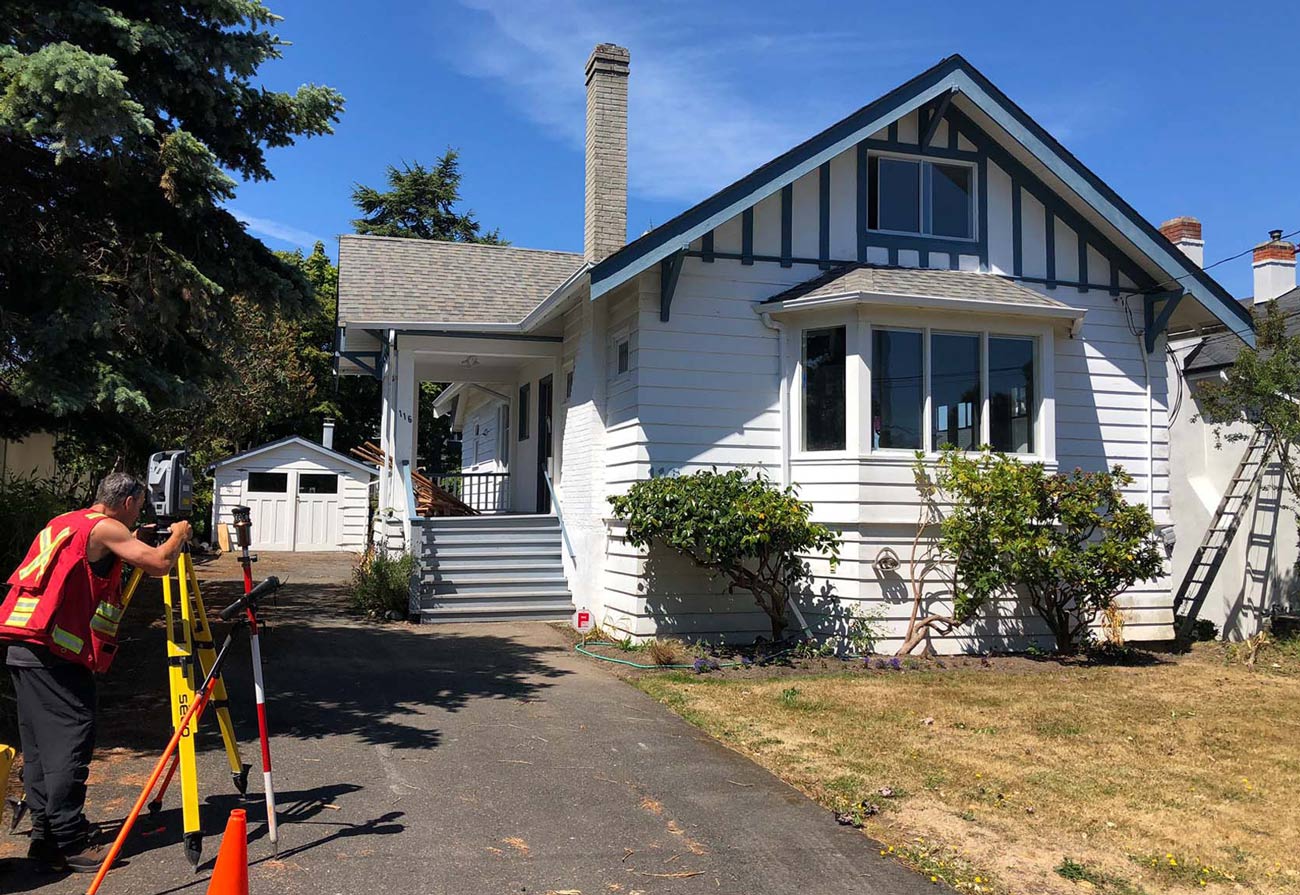
When planning a home renovation in Victoria, Saanich, Oak Bay, or anywhere else on Vancouver Island, many homeowners are surprised to discover that their project may require a survey prepared by a BC Land Surveyor (BCLS). Whether you are building a new deck, adding a secondary suite, constructing a garage, or extending your home’s footprint, municipalities often require accurate survey information before issuing a building permit.

At Polaris Land Surveying, we help homeowners navigate these permit requirements by providing accurate Building Location Certificates, boundary surveys, and site support services across Greater Victoria and Vancouver Island. Understanding when a survey is required can help you avoid costly delays, redesigns, and permit issues during your renovation project.

Here’s what homeowners should know before starting a renovation project.

1. Why Municipalities Require Surveys for Renovations

Municipalities across BC enforce zoning bylaws that establish setback requirements — the minimum distance structures must maintain from property lines, roads, utility corridors, and natural features. Before approving a building permit, municipal staff need to confirm that your proposed construction complies with those setbacks.

If there is no current survey on file, or if existing records are outdated, the municipality may require a Building Location Certificate or boundary survey before the permit can proceed. This helps prevent situations where new structures accidentally encroach onto neighbouring properties or utility easements.

For many homeowners, this is the “permit wall” that unexpectedly delays renovation plans.

2. Renovation Projects That Commonly Require a Survey

Certain projects are much more likely to trigger survey requirements during the permit process.

  • Decks and patios: Elevated or attached decks in municipalities like Victoria and Saanich often require setback verification before permits are approved.
  • Home additions: Any project that expands the existing footprint of the house will usually require accurate boundary information.
  • Detached garages and accessory buildings: New structures near property lines frequently require a survey to confirm placement compliance.
  • Garden suites and laneway homes: With BC’s new Small-Scale Multi-Unit Housing legislation (Bill 44), many homeowners are adding secondary housing units that require updated survey information.
  • Retaining walls and drainage work: Larger retaining walls near lot boundaries can also trigger permit and survey requirements.

Having an accurate survey early in the planning process helps homeowners avoid redesigning projects after permit review.

3. Setback Rules Vary Across Municipalities

One important factor homeowners often overlook is that setback requirements differ significantly between municipalities.

In Saanich, zoning regulations vary widely depending on neighbourhood and lot type. Properties in established residential areas may have strict setback and lot coverage requirements tied to current zoning regulations.

In the City of Victoria, older neighbourhoods frequently contain irregular lot configurations and homes built close to property lines, making accurate surveys especially important during renovations.

In Oak Bay, heritage character and mature residential neighbourhoods often come with carefully enforced setback requirements for additions, garages, and accessory structures.

Because these rules vary, an accurate Building Location Certificate can help both homeowners and contractors understand what is actually possible before finalizing renovation plans.

4. What a BCLS Provides During a Renovation Project

A BC Land Surveyor is the only professional in British Columbia authorized to legally establish property boundaries and prepare survey documentation relied upon by municipalities and lenders.

Depending on the renovation project, a BCLS may provide:

  • Building Location Certificates (BLCs): Documents showing existing structures in relation to property lines, easements, and rights-of-way.
  • Boundary Surveys: Surveys that physically locate or re-establish legal property corners when boundaries are unclear or disputed.
  • Site Plan Support: Accurate survey information used by contractors, designers, and architects when planning new construction.

At Polaris Land Surveying, all of our land surveyors are licensed and regulated by the Association of BC Land Surveyors (ABCLS), ensuring homeowners receive certified and reliable documentation for their permit applications.

5. When You May — and May Not — Need a Full Survey

Not every renovation project requires a survey. Interior-only renovations, such as kitchen upgrades or basement finishing, typically do not involve setback or boundary concerns.

However, you are much more likely to need a survey if:

  • The project adds to the building footprint
  • You are constructing a new detached structure
  • Your property has irregular lot lines or unusual dimensions
  • The property borders a creek, ravine, or natural boundary
  • There are existing easements or rights-of-way registered on title
  • The municipality indicates there is no current survey on file
  • A neighbour dispute exists regarding the property boundary

When in doubt, speaking with a surveyor early in the process can save significant time and expense later.
——————————————————————————–

Quick Checklist: Do You Need a BCLS for Your Renovation?

Before applying for a building permit anywhere on Vancouver Island, consider the following:

  • Does your project extend the building footprint or add a new structure?
  • Do you know the exact legal location of your property boundaries?
  • Are there easements, rights-of-way, or encumbrances registered against the title?
  • Does your municipality already have a current survey on file?
  • Does your proposed project comply with current zoning setback requirements?

All of the Building Location Certificates and boundary surveys provided by Polaris Land Surveying are prepared to support municipal permit applications and renovation planning throughout Greater Victoria and Vancouver Island.

Whether you are planning a deck in Victoria, a garden suite in Saanich, or a home addition in Oak Bay, our team is ready to help you move your project forward with accurate, certified survey information. Contact Polaris Land Surveying today to discuss your renovation project.

A valley with a lake, surrounded by forest

5 Things to Look for in a Surveyor’s Certificate When Buying a Home on Vancouver Island

Buying a home in Victoria, the Cowichan Valley, or anywhere on Vancouver Island is a major commitment that requires thorough due diligence to protect your investment. A BC Land Surveyor’s Building Location Certificate, also known as a BLC or Location Certificate, is a critical document used by homebuyers and real estate agents to understand the physical and legal realities of a property. At Polaris Land Surveying, we act as your local “spatial problem solvers,” helping you navigate everything from building permit requirements to boundary disputes in BC.

While some buyers assume title insurance is sufficient, understanding the difference between a survey certificate and title insurance in BC is vital. While insurance may cover financial loss, only a certified survey provides the physical certainty of where your boundaries lie.

Here are five essential elements to look for in your surveyor’s certificate.

1. Encroachments and Property Structures

A primary purpose of a residential survey is to identify if any structures, such as fences, sheds, or retaining walls, cross the legal property line. Identifying these early can prevent emotional boundary disputes in BC with neighbours. A location certificate will provide certainty that the structures and improvements are actually contained within the limits of the property being purchased.

2. Local Zoning Setbacks

Each municipality across Vancouver Island has specific bylaws regarding how close a structure can be to the property line. Your certificate will show if the home complies with these, such as Oak Bay renovation setbacks or Saanich building permit survey requirements. This is particularly important for those finding a surveyor for a home addition or a home renovation, as non-compliance can lead to a “permit wall” at city hall.

3. Registered Easements and Rights-of-Way

Properties often have registered easements or rights of way that allow utility companies or neighbors to access portions of the land. A BLC highlights these areas, which we verify through extensive research at the Land Title and Survey Authority of BC (LTSA). Understanding these registered charges is crucial, as they can limit where you are allowed to build or landscape.

4. Natural Boundaries and Terrain

Vancouver Island’s geography, featuring rugged coastlines and creeks, means many properties have “natural boundaries”. These boundaries can shift over time, and an accurate survey is needed to define exactly where your private land ends. Additionally, property survey costs in BC can be affected by this terrain; for example, a one-acre property with a forest and a creek may have different land surveyor fees on Vancouver Island than a flat city lot.

5. Professional BCLS Certification and Date

To be accepted by a municipality or lender, the certificate must be signed and sealed by a qualified BCLS (British Columbia Land Surveyor). It is also important to check the date; with BC’s new Small-Scale Multi-Unit Housing (SSMU) legislation (Bill 44), older surveys may not reflect the potential for new density, such as a garden suite or multiplex. You can verify a surveyor’s credentials through the Association of BC Land Surveyors.

All of the land surveyors at Polaris Land Surveying Inc. are certified BCLS, and we provide the appropriate documentation for each requested service.

——————————————————————————–

Vancouver Island Homebuyer’s Checklist

When reviewing a location certificate for a property anywhere on Vancouver Island, ensure it covers these critical points:

  • Encroachments: Are all structures (fences, decks, sheds) confirmed to be within the property lines?
  • Municipal Compliance: Does the property meet specific local setbacks for areas like Saanich, Oak Bay, or Duncan?
  • Development Potential (Bill 44): Does the survey provide the necessary data to explore Small-Scale Multi-Unit Housing or subdividing?
  • Verified Easements: Are all rights-of-way clearly mapped according to current LTSA records?
  • Recent BCLS Certification: Is the document current and signed by a licensed BC land surveyor?

All of the building location certificates provided by Polaris Land Surveying Inc. cover these criteria, and more, given the parameters of the requested service.

Whether you are purchasing a home in the Alberni Valley or a rural lot in the Gulf Islands, our team is ready to provide the high-quality land surveying services you need. Contact Polaris Land Surveying today to ensure your property boundaries are secure.